

High-Polyphenol Olive Oil: Is It Worth It? How to Read the Lab Report

Is high-polyphenol olive oil worth the higher price? Often, yes, if a real lab report backs the number on the label. Polyphenols shape the taste, the freshness, and how well the oil holds up. But on a shelf, a mass-produced supermarket oil and a genuinely high-polyphenol extra virgin olive oil look the same.
Only a lab report can confirm how much a bottle contains, and the report is only useful if you know how to read it. This guide explains what polyphenols are, what counts as "high," why two labs can disagree on the same bottle, how fast the number fades, and how to check the report yourself, step by step.
What are polyphenols in olive oil?
Polyphenols are natural compounds in olives, and extra virgin olive oil is the only grade that keeps a meaningful amount of them. They move into the oil when the fruit is crushed and malaxed. Water-loving by nature, only a small share makes it into the oil; most leave with the vegetation water. What stays gives good olive oil its bitterness and its peppery bite.
The most studied ones in olive oil are:
- Hydroxytyrosol and tyrosol, and the larger molecules built from them. These are the compounds the European health claim is written around.
- Oleuropein derivatives (including oleuropein aglycone and oleacein). They carry most of the bitterness you taste in early-harvest oil.
- Oleocanthal. It causes the tickle at the back of the throat. In 2005, researchers reported that it inhibits the same COX enzymes as ibuprofen in lab tests.
Polyphenols also protect the oil itself. They slow oxidation, the process that makes oil go stale. That is one reason a high-polyphenol extra virgin olive oil often stays fresh longer than a low-polyphenol one. A little bitterness and a little cough are not flaws. In a young, polyphenol-rich oil, they are good signs. For the full picture, see our guide to polyphenols in olive oil.
What is considered high-polyphenol olive oil?
No US law defines "high-polyphenol." Producers, retailers, and writers each use their own ladder, which is why you see the same oil called "high" in one place and "moderate" in another. Here is how the common scales line up, all in milligrams per kilogram (mg/kg). You may also see mg/L or "ppm." For practical comparison, mg/kg and ppm mean the same thing.
| Reported level (mg/kg) | What it usually suggests |
|---|---|
| Under about 150 | Mild oil, often late harvest, a mild variety, or an old bottle |
| About 150–250 | Moderate; common in everyday extra virgin oils |
| About 250–500 | High; noticeable bitterness and pepper. 250 is the level tied to the EU polyphenol health claim (see below) |
| About 500–800 | Higher still; usually early-harvest oil from a robust variety. Some sellers start "high phenolic" at 500 |
| About 800–1,000 | Very high; strongly bitter and pungent |
| 1,000 and up | Ultra-high. Intensely bitter and pungent; often taken by the spoonful rather than used for cooking |
These ranges are a rule of thumb, not an official standard. Variety, climate, harvest timing, milling, storage, and the lab method all move the number.
Where the 250 mg/kg number comes from
The European Food Safety Authority reviewed the evidence on olive oil polyphenols in 2011. It accepted one claim: olive oil polyphenols contribute to the protection of blood lipids from oxidative stress. The condition is that 20 g of oil (about 1.5 tablespoons) provides at least 5 mg of hydroxytyrosol and its derivatives. Divide 5 mg by 20 g and you get 250 mg/kg. The EU wrote that claim into law in Regulation 432/2012.
Two details matter. First, the claim counts hydroxytyrosol and its derivatives, measured by HPLC, not "total polyphenols" from any test. Second, that rule applies in the European Union, not in the United States. This article makes no medical claims. Treat the number as a quality marker and a tasting guide, not a treatment.
What is the highest polyphenol olive oil? (ultra-high polyphenol levels)
The highest polyphenol olive oils are called "ultra-high polyphenol" oils. Most sellers use that label for oils that test at 1,000 mg/kg (1,000 ppm) or more. A few lots report well above that. For comparison, a typical supermarket extra virgin often sits closer to 100–250.
Ultra-high oils come from a narrow set of choices:
- Very early harvest. Olives are picked when they are still hard and green, weeks before most growers start. Yield is low, so the oil costs more.
- Robust varieties. Koroneiki and Kalamon from Greece, Coratina from Italy, and Picual from Spain are among the cultivars that can reach these levels in a good year.
- Fast, cool milling and careful storage. Every delay or warm step lowers the number.
What to expect in the glass: intense bitterness and a strong throat burn that can make you cough more than once. Many people take ultra-high oils by the spoonful or drizzle a little over food rather than cook with them.
Before you pay the premium, check three things:
- The method. Many 1,000+ ppm claims come from colorimetric or NMR tests, which can read higher than HPLC. Ask which method the lab used.
- The test date. Ultra-high numbers fade like any others. A 1,200 ppm result from last year may not describe the bottle you open today.
- The rest of the report. Acidity, peroxide value, and taste still have to pass extra virgin standards.
Higher is not automatically better. No human trial has compared 1,000+ ppm oils with fresh oils in the 300–600 range. For most kitchens, a fresh, honest, well-tested oil matters more than chasing the biggest number.
Why two labs can give different numbers
This is the gap most "best of" lists skip. A polyphenol number means little until you know how it was measured. Three methods are common:
- Colorimetric (Folin-Ciocalteu). An older color test. It reacts with a broad group of compounds, not only olive phenols, so it tends to read higher. It is cheap and fast.
- HPLC. Liquid chromatography separates and measures specific compounds, such as tyrosol, hydroxytyrosol, and their derivatives. The International Olive Council publishes the standard HPLC method for olive oil biophenols (COI/T.20/Doc. No 29). It is the reference method behind the EU claim.
- NMR. Nuclear magnetic resonance reads major compounds such as oleocanthal and oleacein directly. It is popular with high-phenolic producers. Its totals do not line up one-to-one with HPLC; some brands report the same oil about 20% apart between the two.
As an analytical chemist, I read the method line before the number. Our own batch shows why. The same KORAJE Picual reads 454 mg/kg by Folin-Ciocalteu and about 400 mg/kg by HPLC. Same oil, two honest numbers. If a brand does not name the method, ask. If it will not tell you, that is your answer.
Polyphenols fade: the number has a date
A lab report is a snapshot. It shows the polyphenols on the day the sample was tested, not on the day you pour.
A 2022 study in Foods followed three extra virgin oils for 15 months. Stored cold and dark at 4 °C, they still lost roughly 54–68% of their oleocanthal and oleacein. Stored at room temperature in light, those compounds fell below detection within 7 to 12 months. Same oil, same start, very different end.
So when you compare bottles, compare two things: the number, and the date it was measured. A 600 mg/kg report from two harvests ago may describe a weaker oil than a fresh 400 mg/kg report. For more on how fast quality slips, see the science of freshness in olive oil.
What affects polyphenol content?
High polyphenols come from four choices: the right olive, picked green, milled fast, and kept cool.
- Olive variety. Some cultivars are naturally richer in polyphenols. Picual, Koroneiki, and Coratina are among the best known.
- Harvest timing. Early-harvest olives, picked green, carry far more polyphenols than ripe black fruit. As the olive ripens, oil yield rises and polyphenols drop. Early harvest trades yield for quality.
- Time to mill. The faster olives are milled after picking, the more polyphenols survive. Delays mean bruising, fermentation, and oxidation.
- Extraction temperature. Cold extraction, below 27 °C and ideally lower, keeps polyphenols and aroma. Warmer malaxation raises yield and lowers quality.
- Storage. Heat, light, and oxygen break polyphenols down. Dark glass or tins in a cool cupboard protect them best.
| Type | How it is made | Typical taste | Polyphenols |
|---|---|---|---|
| Early-harvest extra virgin | Green olives, cold extraction, mechanical only | Green, bitter, peppery | Usually higher |
| Regular-harvest extra virgin | Riper olives, same virgin methods | Softer, rounder, fruity | Usually lower |
| Refined, or plain "olive oil" blends | Treated to remove flaws, often blended with some virgin oil | Mild, neutral | Much lower |
Early harvest also costs more to make. Green olives hold less oil than ripe ones, so each tree gives fewer bottles, and the fruit has to be picked and milled fast.
How to verify a high-polyphenol claim before you buy
Labels don't always make it easy. A trustworthy purchase checks several signals, not one.
On the label
- Harvest date, not just a "best by" date. Use within 18 months of harvest, sooner for peak polyphenols.
- "Early harvest" wording: a strong hint of higher polyphenol potential.
- Monovarietal and single-origin sourcing. You know which olive and where it grew. A protected designation (PDO) adds traceability.
- Dark glass or a tin. Light speeds up oxidation.
- Independent testing. Reports from an outside lab carry more weight than internal claims.
Researchers at the UC Davis Olive Center have studied olive oil quality and labeling in the US market. Their work is a useful place to learn why testing and labeling matter.
On the lab report
You only need a handful of lines. (For a line-by-line walkthrough, see how to read an olive oil lab report.)
- Polyphenols or total phenols: check the unit, the method, and the test date.
- Free fatty acidity: shows how well the producer handled the olives. Damaged or poorly stored fruit raises it. It must be at or below 0.8% for extra virgin under the USDA standard. Top producers report far lower.
- Peroxide value: measures early oxidation. Lower is better. The extra virgin limit is 20 meq O₂/kg. Fresh, well-made oil sits well under that.
- K232, K270, and ΔK: absorbance readings that flag aged, refined, or poorly stored oil. You do not need to understand the chemistry. Just confirm they fall within extra virgin limits.
- Batch number and harvest year: they should match your bottle. A generic report with no lot tells you very little.
A high polyphenol number does not make an oil extra virgin. An oil can be rich in polyphenols and still fail on acidity, peroxide value, or taste. Read the whole report.
Red flags
- A polyphenol claim with no lab report
- A report with no batch number, no date, or no named lab
- No testing method named
- Vague words like "premium" or "polyphenol-rich" with no numbers behind them
- A huge number from a colorimetric test presented as if it were HPLC
Trust your palate
Taste is a good free test. A genuinely high-polyphenol EVOO is bold: green, grassy or tomato-leaf aroma, a clear bitterness on the middle of the tongue, and a peppery finish that lingers. Mild, buttery, or neutral olive oils are almost always low in polyphenols.
Is high-polyphenol olive oil worth it?
Yes, when you use it where the polyphenols survive: raw or on gentle heat.
Higher polyphenols make sense when you:
- Use oil raw, drizzled over salads, soups, vegetables, fish, or good bread
- Enjoy bold, green, peppery flavors
- Want an oil that stays fresh longer after opening
- Like knowing exactly what is in your bottle
A milder, cheaper oil may be enough when you:
- Deep-fry or use large volumes
- Prefer a soft, buttery taste
- Bake where the flavor disappears
Judge the price per serving, not per bottle. A 500 ml bottle holds about 34 tablespoons. At $58.99, that is about $1.75 a tablespoon. Used as a finishing oil, a teaspoon over soup or a tablespoon on a salad, one bottle lasts a long time.
Many households keep both: a robust early-harvest bottle for finishing, and a simpler oil for the pan. Higher is not always better, either. Past a point, oil turns harsh, and no human trial shows that 1,500 mg/kg does more for you than a fresh, well-made oil in the 300–600 range.
How much high-polyphenol olive oil per day?
The math is simple. Multiply the polyphenol level by your serving. A tablespoon of olive oil weighs about 13.5 g, so 20 g is about 1.5 tablespoons.
| Oil level (mg/kg) | Phenols in 20 g (≈1.5 tbsp) |
|---|---|
| 150 | ≈3 mg |
| 250 | ≈5 mg |
| 400 | ≈8 mg |
| 1,000 | ≈20 mg |
In the EUROLIVE trial, 200 healthy men took about 25 mL of olive oil a day, with oils at roughly 3, 164, and 366 mg/kg. HDL cholesterol rose and markers of LDL oxidation fell more as the polyphenol level went up. The large PREDIMED trial, with more than 7,400 participants, found fewer major cardiovascular events in people on a Mediterranean diet supplemented with extra virgin olive oil than in a reduced-fat control diet. Those are findings about diets and populations, not a dose for you. Olive oil is food. Talk to your doctor about anything medical.
Make it part of your routine
Food does not need to feel complicated to be good for you. A spoonful of excellent oil over warm vegetables is a small pleasure that fits easily into a regular day. Little habits like that tend to stick.
For daily routines, see the daily spoonful of high-polyphenol olive oil.
How to use, taste, and store high-polyphenol olive oil
Use it
- Raw or as a finishing oil. Drizzle it just before serving to keep the polyphenols and let the flavor shine.
- At moderate heat. Genuine EVOO is more heat-stable than its reputation suggests, and polyphenol-rich oil has more antioxidants to protect it. It works for sautéing and roasting.
Taste it
- Pour a teaspoon into a small glass.
- Warm the glass in your hand and smell the oil.
- Sip it and let it coat your mouth.
- Notice the bitterness, then the pepper in your throat.
Fresh grass, green tomato, or artichoke notes are common in early-harvest oils.
Store it
- Keep the bottle in a dark cupboard, never next to the stove.
- Close the cap tightly after each use.
- Finish it within a few months of opening. Treat it like fresh produce, not a pantry staple that lasts forever.
The Picual advantage — and KORAJE
If you want the highest natural polyphenol potential in a single olive variety, Picual is the place to start. It is native to Jaén in Andalusia, the largest olive-oil-producing province in the world. Picual olives are naturally:
- Among the richest in polyphenols of any cultivar
- Very high in oleic acid, which makes the oil stable and slow to oxidize
- Rich in tocopherols (vitamin E), another layer of antioxidant protection
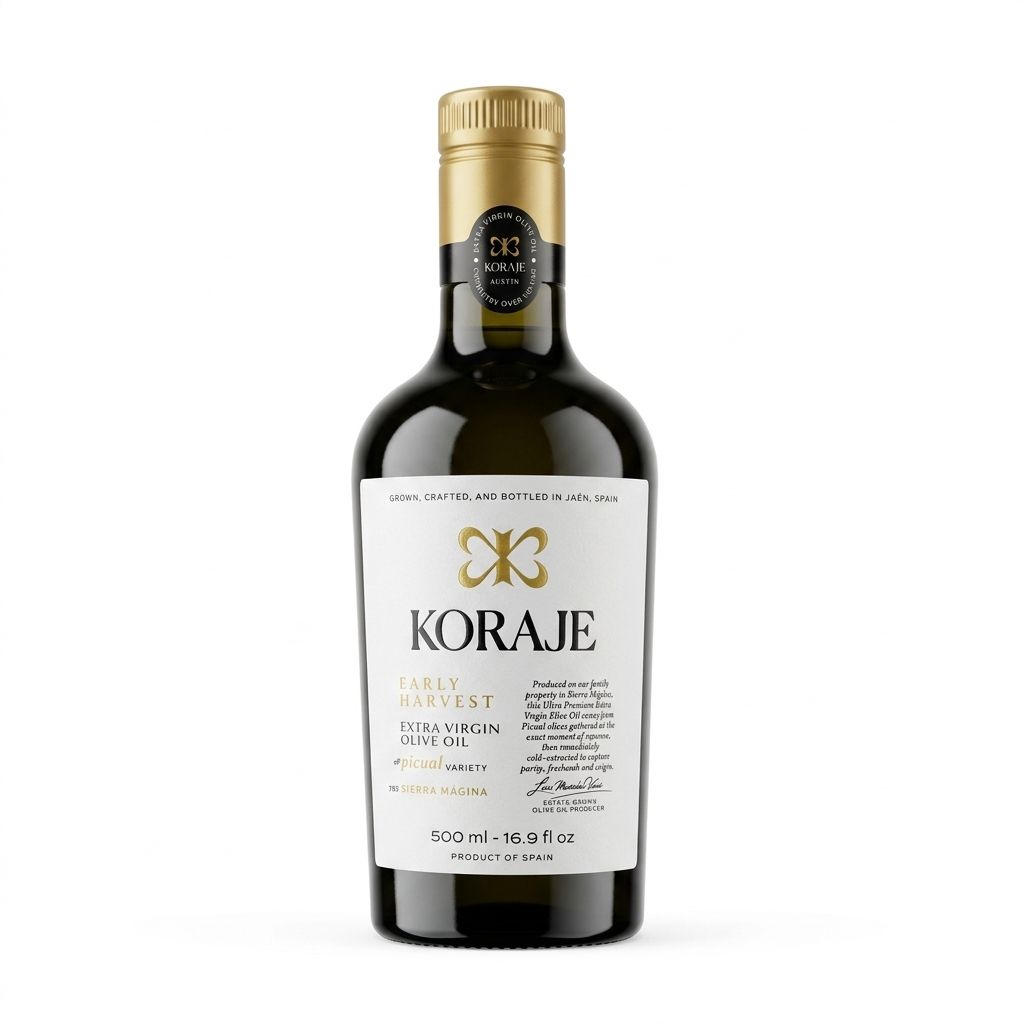
KORAJE Early-Harvest Picual Extra Virgin Olive Oil comes from single-origin Picual olives in Jaén, harvested green and cold-extracted (cold pressed) within 2 hours at under 21 °C. The current listed batch reports 454 mg/kg of polyphenols by Folin-Ciocalteu and about 400 mg/kg by HPLC, which puts it in the high range on the scale above. Expect a vivid green-fruity nose, pronounced bitterness, and a persistent peppery finish.
Batch numbers change from harvest to harvest. Check the report that matches the bottle you buy.
Final thoughts: use the report, not just the label
High-polyphenol olive oil is worth the price when a batch-specific lab report backs it up. Check the number, the method, the test date, the acidity, the peroxide value, and the harvest date. The bitterness and the pepper tell you the polyphenols made it into the bottle. The report proves it.
If you want an oil that delivers on both flavor and transparency, start with KORAJE Early-Harvest Picual Extra Virgin Olive Oil and compare its batch details with any other bottle you are considering.
Take a moment each day to enjoy good food and good company. Small, simple habits are often the ones that last.
Frequently asked questions
What is high-polyphenol olive oil?
It is extra virgin olive oil with a high level of natural phenolic compounds, such as hydroxytyrosol, oleuropein derivatives, oleocanthal, and oleacein. There is no legal US definition. Most people treat 250 mg/kg and up as high, 800 mg/kg and up as very high, and 1,000 mg/kg and up as ultra-high.
What are the benefits of high-polyphenol olive oil?
In the kitchen, more polyphenols mean a bolder, greener, more peppery flavor and an oil that resists going stale. In research, the EU accepts one claim: olive oil polyphenols help protect blood lipids from oxidative stress, at 5 mg of hydroxytyrosol and its derivatives per 20 g of oil. Studies such as EUROLIVE and PREDIMED looked at diets and populations, not personal doses. Olive oil is food, not a treatment.
What is a good polyphenol level for olive oil?
For everyday cooking and finishing, a fresh oil at 250–500 mg/kg is a strong choice. Above that, flavor gets more intense. Always check the testing method and the test date along with the number.
Which is the best high-polyphenol olive oil?
The highest readings usually come from very early-harvest oils of robust varieties such as Koroneiki, Kalamon, Picual, and Coratina, sometimes above 1,000 mg/kg. Rankings change every harvest, and numbers measured by different methods cannot be compared directly. The best high-polyphenol olive oil for you is a fresh one, with a named method, a recent test date, and a taste you enjoy.
Does a higher polyphenol count always mean better olive oil?
No. Polyphenols are one quality marker. Freshness, acidity, peroxide value, and taste matter just as much. A high number on a stale or defective oil is not a good buy.
Why does high-polyphenol olive oil taste bitter and spicy?
Oleuropein derivatives create the bitterness, and oleocanthal creates the peppery sensation in the throat. Both are normal in fresh, early-harvest oil.
Why do labs report different polyphenol numbers for the same oil?
They use different methods. Colorimetric tests read a broad group of compounds and run high. HPLC measures specific compounds and is the IOC reference method. NMR measures major compounds directly. Compare numbers only when the method and test date match.
How do I know a lab report is real?
Look for a named laboratory, a testing method, a batch or lot number, and a date. Match the batch number to your bottle.
Do polyphenols in olive oil decrease over time?
Yes. In one 15-month study, oleocanthal and oleacein dropped by more than half even in cold, dark storage, and disappeared within a year in warm, lit storage. Buy recent harvests, keep the bottle cool and dark, and finish it within a few months of opening.
Is early-harvest olive oil always high in polyphenols?
Usually, but not always. Early harvest raises the potential. Variety, climate, milling speed, temperature, and storage decide the final number.
Can I cook with high-polyphenol olive oil?
Yes. Prolonged high heat lowers polyphenols, but polyphenol-rich EVOO is stable for sautéing and roasting at moderate heat. Many people save it for finishing so they can enjoy the full flavor.
How should I store high-polyphenol olive oil?
In a cool, dark place, away from the stove, in dark glass or a tin, with the cap tight. Use it within 12–18 months of harvest and within a few months of opening.
Is KORAJE olive oil high in polyphenols?
Yes. KORAJE Early-Harvest Picual EVOO is made from single-origin Picual olives harvested green and cold-extracted within 2 hours at under 21 °C. The current listed batch reports 454 mg/kg of polyphenols by Folin-Ciocalteu and about 400 mg/kg by HPLC. Check the batch report that matches your bottle.
References
- EFSA Panel on Dietetic Products, Nutrition and Allergies (2011). Scientific Opinion on the substantiation of health claims related to polyphenols in olive and protection of LDL particles from oxidative damage. EFSA Journal, 9(4), 2033. https://doi.org/10.2903/j.efsa.2011.2033
- European Commission (2012). Commission Regulation (EU) No 432/2012 establishing a list of permitted health claims made on foods. Official Journal of the European Union, L 136, 1–40. https://eur-lex.europa.eu/eli/reg/2012/432/oj
- International Olive Council (2017). Determination of biophenols in olive oils by HPLC. COI/T.20/Doc. No 29/Rev.1. https://www.internationaloliveoil.org/wp-content/uploads/2019/11/COI-T.20-Doc.-No-29-Rev-1-2017.pdf
- USDA Agricultural Marketing Service (2010). United States Standards for Grades of Olive Oil and Olive-Pomace Oil. https://www.ams.usda.gov/sites/default/files/media/Olive_Oil_and_Olive-Pomace_Oil_Standard%5B1%5D.pdf
- Esposito Salsano, J., Digiacomo, M., Cuffaro, D., Bertini, S., & Macchia, M. (2022). Content variations in oleocanthalic acid and other phenolic compounds in extra-virgin olive oil during storage. Foods, 11(9), 1354. https://doi.org/10.3390/foods11091354
- Beauchamp, G.K., Keast, R.S.J., Morel, D., et al. (2005). Ibuprofen-like activity in extra-virgin olive oil. Nature, 437, 45–46. https://doi.org/10.1038/437045a
- Covas, M.I., Nyyssönen, K., Poulsen, H.E., et al. (2006). The effect of polyphenols in olive oil on heart disease risk factors: a randomized trial. Annals of Internal Medicine, 145(5), 333–341. https://doi.org/10.7326/0003-4819-145-5-200609050-00006
- Estruch, R., Ros, E., Salas-Salvadó, J., et al. (2018). Primary prevention of cardiovascular disease with a Mediterranean diet supplemented with extra-virgin olive oil or nuts. New England Journal of Medicine, 378, e34. https://doi.org/10.1056/NEJMoa1800389

Written by Raj Mahat
Analytical Chemist
Metabolomics/ Lipidomics
EVOO Sommelier- O.N.A.O.O., Italy
Certified EVOO Sommelier- ESAO, Spain





Leave a comment
This site is protected by hCaptcha and the hCaptcha Privacy Policy and Terms of Service apply.