

How to Read an Olive Oil Lab Report Like a Chemist

An olive oil lab report answers four questions. Is it fresh? Is it pure? What is in it? Is it safe? Each entry is one measurement, made by a set method, compared with a legal limit. Below is our own report, every result explained in plain words.
On this page
- How to read each entry
- Freshness and quality
- Purity and authenticity
- Composition
- Safety
- Red flags on any olive oil lab report
- Final Thoughts
- FAQs
Why a lab report beats the label
A label can say anything. "Extra virgin." "Cold pressed." "Premium." None of it is measured. A lab report is. It is the only honest way to tell if olive oil is real.
The rules come from the International Olive Council (IOC), the body that sets the world's olive oil standards. To be extra virgin, an oil must pass every chemical limit and a trained tasting panel. Miss one limit and it is not extra virgin, whatever the label says.
Kitchen tricks do not work. The fridge test, for example, tells you almost nothing: whether oil clouds in the cold depends on its fat profile and waxes, not on whether it is real. Only a lab can answer the question.
How to read each entry
Result: Our number. "<" means below that value. "Not detected" means below the smallest amount the lab can reliably measure.
Limit: The limit an extra virgin olive oil must meet. "≤" means at or below. "≥" means at or above. Some parameters describe the oil and have no limit.
Method: How it was measured, and the official IOC method where one exists. "COI/T.20/Doc. No 34" is the IOC's recipe for acidity, so every accredited lab runs it the same way and results can be compared. Some tests, like pesticides, are not IOC tests; we name the technique instead.
Below each entry, a few plain words on what the number means for you.
1. Freshness and quality: has the oil been damaged?
These tests show how the fruit was handled and how the oil has aged. Bruised olives, slow milling, heat, light and air all push the chemical numbers up; lower is better. The last four entries are the tasting panel. By law, extra virgin must pass both the lab and the tasters.
Free acidity: what olive oil acidity means
Result: 0.11 %
Limit: ≤ 0.80 %
Method: Titration, COI/T.20/Doc. No 34
How much the fat has begun to break apart. Damaged or late fruit raises it. Ours is about one-seventh of the limit. Acidity is measured, not tasted: you cannot taste it.
Acidity is not the oil's pH or sourness. It is the share of fatty acids that have broken free from the fat molecule, expressed as oleic acid. Lower means healthier fruit and faster milling.
Peroxide value
Result: 9.2 meq O₂/kg
Limit: ≤ 20 meq O₂/kg
Method: Titration, COI/T.20/Doc. No 35
The first sign of oxidation: oil reacting with air. It climbs with heat, light and time. Ours is under half the limit.
K232
Result: 1.84
Limit: ≤ 2.50
Method: UV spectrophotometry, COI/T.20/Doc. No 19
Early oxidation products absorb UV light at 232 nm. This catches damage the peroxide value can miss.
K268 (K270)
Result: 0.14
Limit: ≤ 0.22
Method: UV spectrophotometry, COI/T.20/Doc. No 19
Later oxidation products, and compounds made during refining. A low value means no old or refined oil is hiding in the bottle.
ΔK
Result: < 0.01
Limit: ≤ 0.01
Method: UV spectrophotometry, COI/T.20/Doc. No 19
A sharp peak near 270 nm is the fingerprint of refined oil. Ours is below the smallest value the test reports.
Median of defects (sensory)
Result: 0
Limit: = 0
Method: Panel test by trained tasters, COI/T.20/Doc. No 15
A panel of 8 to 12 trained tasters scores faults such as musty, winey or rancid. Extra virgin must have none. Ours has none.
Median of fruitiness (sensory)
Result: 7
Limit: > 0
Method: Panel test by trained tasters, COI/T.20/Doc. No 15
How strongly the oil smells and tastes of fresh olives, on a 0 to 10 scale. Above 6 the IOC calls it intense.
Median of bitterness (sensory)
Result: 5
Limit: No limit
Method: Panel test by trained tasters, COI/T.20/Doc. No 15
Bitterness comes from polyphenols, mainly oleacein. It is a positive attribute, not a fault. 3 to 6 is medium.
Median of pungency (sensory)
Result: 5
Limit: No limit
Method: Panel test by trained tasters, COI/T.20/Doc. No 15
The peppery catch in the throat, from oleocanthal. Also a positive attribute. 3 to 6 is medium.
Sources: chemistry from Laboratorio Juan Antonio Tello (Tentamus group), report 60728093500, lot L-H1118826, harvest 2025/26, issued 28 July 2026, sample taken after bottling; the lab runs its own validated procedures based on the IOC methods listed. Sensory from the tasting panel of the PDO Sierra Mágina Regulatory Council, report OR25-0382, 20 October 2025, on tank N11 before bottling, classified extra virgin. A second panel at Laboratorio Tello (report 51024131832, 24 October 2025) also classified it extra virgin, with fruitiness 8 and bitterness and pungency above 5. Sensory scores are rounded to whole numbers.
2. Purity and authenticity: is it only olive oil?
These are the tests fraud cannot pass. They read the oil's molecular fingerprint. Seed oils, refined oil, pomace oil and "soft-deodorized" oil each leave marks here.
Total sterols
Result: 1,089 mg/kg
Limit: ≥ 1,000 mg/kg
Method: Gas chromatography (GC-FID), COI/T.20/Doc. No 26
Sterols are plant compounds every oil carries in its own pattern. Refining strips them out, so low totals point to processed oil.
β-sitosterol (apparent)
Result: 94.9 %
Limit: ≥ 93.0 % of sterols
Method: Gas chromatography (GC-FID), COI/T.20/Doc. No 26
Olive oil's signature sterol. Seed oils bring other sterols that dilute it. Below 93 % suggests a blend.
Erythrodiol + uvaol
Result: 1.6 %
Limit: ≤ 4.5 %
Method: Gas chromatography (GC-FID), COI/T.20/Doc. No 26
These come mostly from olive skins. High values point to pomace oil, which is pulled from leftover paste with solvents.
Diacylglycerols (1,2-DAG / 1,3-DAG)
Result: 87.6 % / 12.4 %
Limit: No IOC limit. 1,2-DAG ≥ 35 % in Australian Standard AS 5264
Method: Gas chromatography (GC-FID), ISO 29822 (not an IOC method)
Fresh oil holds its DAGs in the 1,2 form. Age and heat turn them into 1,3. A high 1,2 share means young oil, gently handled, never heat-treated.
2-glyceryl monopalmitate
Result: 0.7 %
Limit: ≤ 1.0 % (palmitic acid above 14 %; ours is 14.55 %)
Method: Gas chromatography (GC), COI/T.20/Doc. No 23
Checks where palmitic acid sits on the fat molecule. Nature puts it in one place. Man-made "re-esterified" or synthetic oils and fats put it in another.
Main triacylglycerol: OOO + PoPP
Result: 44.18 %
Limit: No limit for a single TAG. The IOC limit is on ΔECN42: ≤ 0.20 (ours < 0.05)
Method: Liquid chromatography (HPLC), COI/T.20/Doc. No 20
Triacylglycerols are the fat molecules themselves. In olive oil the largest peak is triolein (OOO): three oleic acids on a glycerol backbone. It shares its peak with a minor one, PoPP. Seed oils shift this pattern, which ΔECN42 would catch.
Waxes (C42 + C44 + C46)
Result: 20 mg/kg
Limit: ≤ 150 mg/kg
Method: Gas chromatography (GC-FID), COI/T.20/Doc. No 28
Waxes coat the olive skin. Solvent-extracted pomace oil carries far more of them than pressed oil.
Sources: sterols, erythrodiol + uvaol and DAGs from Tello report 60728093500 (after bottling). 2-glyceryl monopalmitate, ΔECN42 and waxes from Tello chemical report 51105114623, tank N11 before bottling, issued 5 November 2025. Main triacylglycerol from a Laboratorio Tello verification report.
3. Composition: what is in the bottle?
These numbers have no pass or fail. They describe the oil. Polyphenols give bitterness and pepper. Fatty acids decide how stable the oil is. Early-harvest Picual is known for both.
Total polyphenols
Result: 454 mg/kg (as caffeic acid)
Limit: No limit
Method: Colorimetry, Folin–Ciocalteu (not an IOC method)
A broad count of antioxidant compounds. Fast and cheap, but it also reacts with things that are not polyphenols, so it reads high. Good for comparing oils, not for claims.
Total biophenols
Result: 397.8 mg/kg (as tyrosol)
Limit: No limit
Method: Liquid chromatography (HPLC), COI/T.20/Doc. No 29
The IOC method. It separates and counts each compound, so it is more specific than the Folin-Ciocalteu method. This is the polyphenol number to trust. For what counts as high, see high-polyphenol olive oil.
Oleocanthal
Result: 44.9 mg/kg (as tyrosol)
Limit: No limit
Method: Liquid chromatography (HPLC), COI/T.20/Doc. No 29
The compound that stings the back of your throat. That cough after a sip is oleocanthal at work, and a sign of fresh oil.
Oleacein
Result: 52.2 mg/kg (as tyrosol)
Limit: No limit
Method: Liquid chromatography (HPLC), COI/T.20/Doc. No 29
Oleocanthal's close relative. It brings bitterness. Both fall as oil ages, so they are also a freshness clock.
Oleic acid (C18:1)
Result: 76.91 %
Limit: 55.0 – 83.0 % (IOC); 55.0 – 85.0 % (EU)
Method: Gas chromatography (fatty acid methyl esters), COI/T.20/Doc. No 33
The main fat in olive oil. More oleic acid means an oil that resists oxidation, on the shelf and in the pan.
Total monounsaturated fat (MUFA)
Result: 78.6 %
Limit: No IOC limit
Method: Gas chromatography (fatty acid methyl esters), COI/T.20/Doc. No 33
All monounsaturated fats together: oleic, palmitoleic, margaroleic and eicosenoic acid. Oleic acid is almost all of it. Calculated from the fatty acid profile.
Linoleic acid (C18:2)
Result: 3.13 %
Limit: 2.5 – 21.0 %
Method: Gas chromatography (fatty acid methyl esters), COI/T.20/Doc. No 33
An omega-6 fat. It oxidizes faster than oleic acid, so a low value adds stability. Seed oils are rich in it.
Linolenic acid (C18:3)
Result: 0.76 %
Limit: ≤ 1.00 %
Method: Gas chromatography (fatty acid methyl esters), COI/T.20/Doc. No 33
An omega-3 fat. Above 1.0 % points to seed oil, such as canola or soybean, mixed in.
Sources: polyphenols, biophenols, oleocanthal and oleacein from Tello report 60728093500 (after bottling). The HPLC biophenol results sit outside that lab's ENAC accreditation scope, as the report states. Fatty acids from Tello chemical report 51105114623, tank N11 before bottling, issued 5 November 2025; total MUFA is our sum of the monounsaturated acids in that report.
A note on health claims. In Europe, an olive oil may carry a polyphenol claim only if it contains at least 5 mg of hydroxytyrosol and its derivatives per 20 g of oil, about 250 mg/kg. That figure counts a specific group of compounds, measured by HPLC. It is not the same as the Folin total, and brands that quote one as the other are comparing different things.
4. Safety: is anything there that should not be?
These tests look for contaminants from farming, processing, packaging and the environment. The goal is simple: nothing found, or far below the limit.
Halogenated solvents
Result: Not detected
Limit: ≤ 0.1 mg/kg each; ≤ 0.2 mg/kg total
Method: Headspace gas chromatography, COI/T.20/Doc. No 8
Chlorinated industrial solvents. They have no place in olive oil and point to contamination if found.
Pesticide residues (multi-residue screen)
Result: Not detected
Limit: EU maximum residue levels, Reg. (EC) 396/2005
Method: LC-MS/MS and GC-MS/MS (not an IOC method)
One run screens hundreds of farm chemicals at trace levels, using the same instruments forensic and clinical labs rely on. The screen covered more than 250 compounds by GC-MS/MS and about 150 by LC-MS/MS. Every one was below 0.010 mg/kg, the lowest level the lab reports.
Diquat and paraquat
Result: Not detected (< 0.01 mg/kg each)
Limit: EU maximum residue levels, Reg. (EC) 396/2005
Method: UPLC-MS/MS (not an IOC method)
Two weedkillers that do not show up in the standard screen, so they need their own test.
Bisphenol A (BPA)
Result: Not detected (< 0.01 mg/kg)
Limit: No olive oil limit. Banned in EU food-contact materials, Reg. (EU) 2024/3190
Method: LC-MS/MS (not an IOC method)
A chemical that can leach from some can linings, tank coatings and plastics. We bottle in glass.
Total aflatoxins (B1, B2, G1, G2)
Result: Not detected (< 0.05 µg/kg)
Limit: No EU limit set for olive oil
Method: HPLC with fluorescence detection (not an IOC method)
Toxins made by moulds. Rare in olive oil, since moulds need water, but worth ruling out.
Lead (Pb)
Result: < 0.020 mg/kg
Limit: ≤ 0.10 mg/kg (EU, Reg. 2023/915)
Method: ICP-MS (not an IOC method)
A toxic metal from soil, air or equipment. Ours is below the lab's smallest measurable amount, at least five times under the limit.
Arsenic (As, total)
Result: < 0.020 mg/kg
Limit: ≤ 0.1 mg/kg (Codex, IOC)
Method: ICP-MS (not an IOC method)
A toxic element that can come from soil or water. Below the lab's smallest measurable amount.
Iron (Fe)
Result: < 1.0 mg/kg
Limit: ≤ 3.0 mg/kg (Codex, IOC)
Method: ICP-MS (not an IOC method)
Picked up from worn mill equipment. Iron speeds up oxidation, so low iron helps the oil keep.
Copper (Cu)
Result: < 0.10 mg/kg
Limit: ≤ 0.1 mg/kg (Codex, IOC)
Method: ICP-MS (not an IOC method)
Like iron, copper speeds up oxidation. It can also come from copper-based sprays in the grove. Below the lab's smallest measurable amount.
Microbiology (aerobic bacteria at 22, 30 and 37 °C; moulds and yeasts; E. coli; Salmonella)
Result: All < 10 CFU/g; Salmonella not detected in 25 g
Limit: No IOC limit
Method: Culture: plate counts; ISO 16649-2 for E. coli; chromogenic agar for Salmonella (not IOC methods)
Olive oil holds almost no water, so bacteria and moulds struggle to live in it. This confirms clean handling from mill to bottle.
Polycyclic aromatic hydrocarbons (benzo[a]pyrene / PAH4)
Result: < 0.5 / < 2.0 µg/kg
Limit: EU: benzo[a]pyrene ≤ 2.0 µg/kg; sum of 4 PAHs ≤ 10.0 µg/kg, Reg. (EU) 2023/915
Method: Chromatography, lab procedure PNT 1.23 (not an IOC method)
Formed by smoke and burning, such as exhaust near the grove or drying with open flame. Low values mean clean air and clean processing.
Sources: halogenated solvents, pesticide multi-residue screen, BPA and aflatoxins from two Laboratorio Tello verification reports run when we selected this producer. Diquat and paraquat, metals, microbiology and PAHs from Tello chemical report 51105114623, tank N11 before bottling, issued 5 November 2025. Metals are covered by accreditation 493/LE1019; the microbiology and diquat/paraquat tests sit outside ENAC scope, as the report states.
Red flags on any olive oil lab report
Use this list on any brand's report, not only ours.
- No date or lot number. A report that cannot be tied to the bottle in your hand proves nothing.
- Tested before bottling only. Oil changes in tanks and transit. Ask for a test on the finished product.
- Numbers crowding the limit. Acidity near 0.8 %, peroxide near 20 or K232 near 2.5 can pass today and fail in a few months.
- ΔK above 0.01, or low sterols. Classic signs of refined oil blended in.
- Linolenic acid above 1.0 % or β-sitosterol below 93 %. Signs of seed oil.
- High waxes or erythrodiol + uvaol. Signs of pomace oil.
- A giant polyphenol number with no method named. Folin and HPLC give different answers. A number without a method is marketing.
- No accredited lab named. Look for ISO/IEC 17025 accreditation, or IOC recognition.
Final thoughts
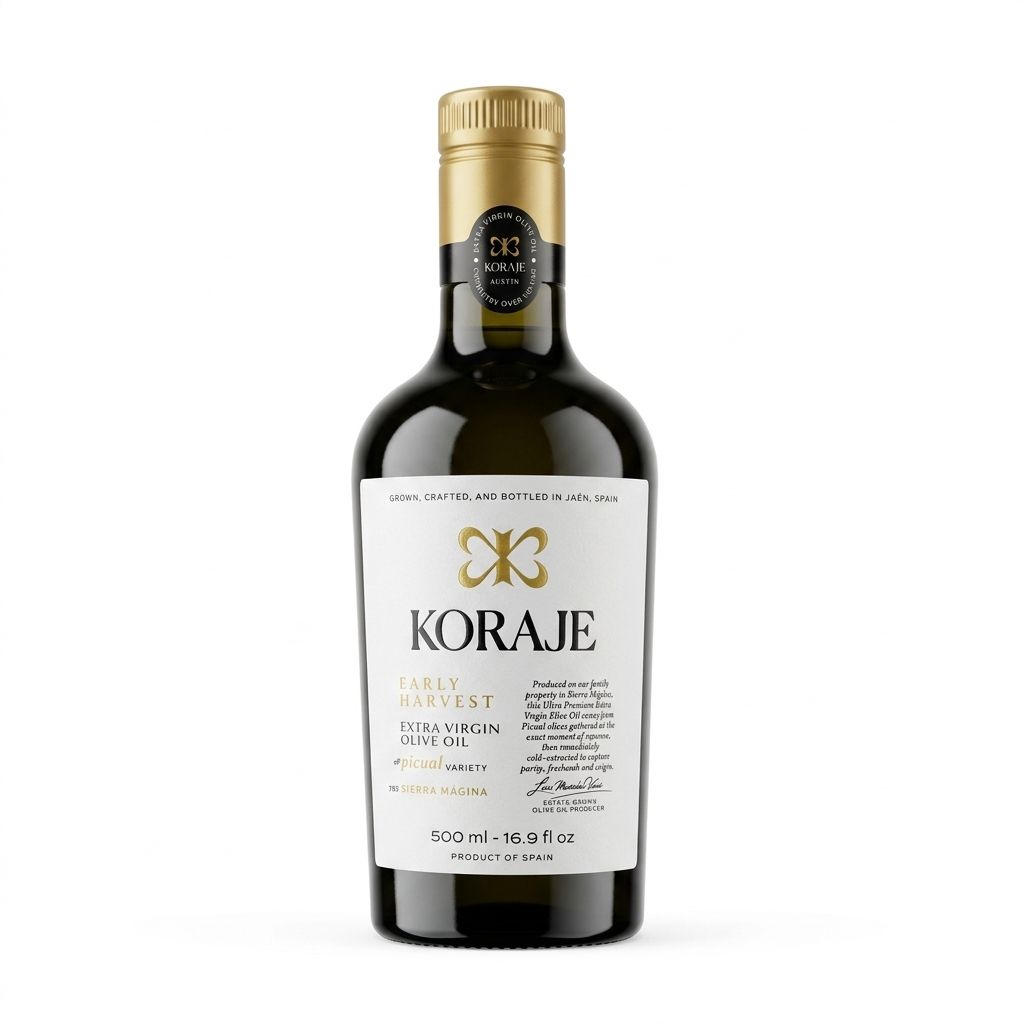
Every number on this page comes from a lab report you can read yourself. Download the full certificate of analysis (PDF), then taste the oil these numbers describe: KORAJE Early-Harvest Picual Extra Virgin Olive Oil.
Verified, not just claimed.
Frequently asked questions
How can you tell if olive oil is real?
Ask for a lab report from an accredited lab, tied to the lot you are buying. Check freshness (acidity, peroxide value, K232, K268, ΔK), purity (sterols, erythrodiol + uvaol, waxes, fatty acids) and a tasting panel result. Home tests like the fridge test do not work.
What is a good acidity level for extra virgin olive oil?
The legal limit is 0.8 %. Good oils sit well below it; early-harvest oils often test between 0.1 and 0.3 %. Acidity cannot be tasted. It is measured by titration in a lab.
What does the peroxide value tell you?
It measures the first stage of oxidation. The limit is 20 meq O₂/kg. A low number means the oil was made from sound fruit and protected from air, heat and light.
What are K232, K268 and ΔK?
They are UV light readings. K232 catches early oxidation. K268 catches later oxidation and refining. ΔK flags refined oil hidden in a blend. All three must be under their limits for an oil to be extra virgin.
Why do polyphenol numbers differ between brands?
Because they use different methods. The Folin method gives a broad total that reads high. The IOC's HPLC method counts individual compounds and reads lower. Always check which method, and which reference compound (caffeic acid or tyrosol), a number is based on.
What is oleocanthal in olive oil?
A natural phenolic compound in fresh extra virgin olive oil. It causes the peppery sting in your throat. It is measured by HPLC, and it fades as oil ages.
References
- International Olive Council. Trade standard applying to olive oils and olive pomace oils, COI/T.15/NC No 3.
- International Olive Council. COI/T.20/Doc. No 34: Determination of free fatty acids, cold method.
- International Olive Council. COI/T.20/Doc. No 35: Determination of peroxide value.
- International Olive Council. COI/T.20/Doc. No 19: Spectrophotometric investigation in the ultraviolet.
- International Olive Council. COI/T.20/Doc. No 26: Determination of the composition and content of sterols, triterpenic dialcohols and aliphatic alcohols by capillary gas chromatography.
- International Olive Council. COI/T.20/Doc. No 23: Determination of the percentage of 2-glyceryl monopalmitate.
- International Olive Council. COI/T.20/Doc. No 20: Determination of the difference between actual and theoretical content of triacylglycerols with ECN 42.
- International Olive Council. COI/T.20/Doc. No 28: Determination of the content of waxes, fatty acid methyl esters and fatty acid ethyl esters by capillary gas chromatography.
- International Olive Council. COI/T.20/Doc. No 29: Determination of biophenols in olive oils by HPLC.
- International Olive Council. COI/T.20/Doc. No 33: Determination of fatty acid methyl esters by gas chromatography.
- International Olive Council. COI/T.20/Doc. No 8: Determination of volatile halogenated solvents.
- ISO 29822: Vegetable fats and oils. Isomeric diacylglycerols. Determination of relative amounts of 1,2- and 1,3-diacylglycerols.
- Standards Australia. AS 5264: Olive oils and olive-pomace oils.
- European Union. Commission Regulation (EU) No 432/2012, health claim on olive oil polyphenols.
- European Union. Regulation (EC) No 396/2005 on maximum residue levels of pesticides.
- European Union. Commission Regulation (EU) 2023/915 on maximum levels for certain contaminants in food.
- European Union. Commission Regulation (EU) 2024/3190 on the use of bisphenol A in food contact materials.

Written by Raj Mahat
Analytical Chemist
Metabolomics/ Lipidomics
EVOO Sommelier- O.N.A.O.O., Italy
Certified EVOO Sommelier- ESAO, Spain





Leave a comment
This site is protected by hCaptcha and the hCaptcha Privacy Policy and Terms of Service apply.