

Olive Oil Oxidation Tests: How Labs Measure Rancidity, Explained Simply

Abstract
Labs test olive oil oxidation in two stages. Peroxide value and UV absorbance (K232) catch the first products of oxidation. K270, the p-anisidine value, TOTOX and gas chromatography of volatile compounds catch the later products that taste rancid. Only peroxide value and the UV tests are part of the official extra virgin grade. The rest are research and industry tools.
Every olive oil starts to oxidize the day it is made. Oxygen meets fat. Heat, light and trace metals speed it up. Polyphenols and vitamin E slow it down. The question is never whether an oil oxidizes. It is how far along it is, and how you would know.
This guide walks through every major test, in plain words. It draws on a 2022 review of oxidation methods by Tarapoulouzi and colleagues in Biomolecules, the International Olive Council (IOC) standard, and our own lab report.
How olive oil oxidation works
Think of it in two acts.
Act one: primary oxidation. Oxygen attacks the unsaturated fats in the oil and forms hydroperoxides. They have almost no smell or taste. You can't detect them, but a lab can.
Act two: secondary oxidation. Hydroperoxides are unstable. They break apart into aldehydes and ketones. These are the molecules that smell of crayons, putty and stale walnuts. A tasting panel calls it the "rancid" defect.
Three things drive the process:
- Autoxidation: oxygen reacting with fat, even in the dark.
- Photo-oxidation: light excites chlorophyll in the oil, which turns ordinary oxygen into a far more reactive form.
- Metals: traces of iron and copper act as catalysts.
What fights back is the oil's minor fraction. The review is clear that an olive oil's oxidative stability depends strongly on its polar phenols, and that storage steadily uses up both phenols and tocopherols (vitamin E). Olive oil's fat profile helps too: mostly monounsaturated oleic acid, with few of the polyunsaturated fats that oxidize fastest.
The three types of rancidity
Oxidation is the main way olive oil goes bad, but not the only one. Food-testing labs such as Eurofins group rancidity into three types:
- Oxidative rancidity. Oxygen breaks down unsaturated fatty acids, sped up by light and heat. The products are aldehydes and ketones, the classic rancid smell. Most of the tests below are built for this type.
- Hydrolytic rancidity. Water splits fatty acids off the triglyceride, the fat molecule's backbone. The freed fatty acids are what a lab reports as free acidity, measured by titration. For extra virgin olive oil the limit is 0.8%. Ours is 0.11%.
- Microbial rancidity. Microorganisms do the damage. Olive oil holds very little water, so bacteria rarely survive in it. Yeasts can persist in unfiltered oil, and some produce lipases, enzymes that split fats the same way hydrolysis does. Filtering removes many of them. Our oil tested below 10 CFU/g for bacteria, yeasts and moulds.
The oxidation tests at a glance
| Test | Stage it measures | What it detects | Official EVOO limit? |
|---|---|---|---|
| Peroxide value (PV) | Primary | Hydroperoxides | Yes: ≤ 20 meq O₂/kg |
| Free acidity (titration) | Hydrolytic rancidity | Free fatty acids | Yes: ≤ 0.80% |
| Ferric thiocyanate | Primary | Hydroperoxides (colour method) | No |
| K232 (UV at 232 nm) | Primary | Conjugated dienes | Yes: ≤ 2.50 |
| K270 / K268 (UV at ~270 nm) | Secondary | Conjugated trienes, aldehydes, ketones | Yes: ≤ 0.22 |
| ΔK | Refining check | Sharp UV peak from refined oil | Yes: ≤ 0.01 |
| p-Anisidine value (p-AV) | Secondary | Aldehydes | No |
| TOTOX | Both | 2 × PV + p-AV | No |
| TBARS | Secondary | Malondialdehyde | No |
| Gas chromatography (headspace) | Secondary | Volatile off-flavour compounds | No |
| Rancimat / induction time | Future stability | How long until oxidation speeds up | No |
| Tasting panel | Secondary | The "rancid" defect | Yes: defects must be 0 |
Tests for primary oxidation
Peroxide value (PV)
The oldest and most used test. A chemist dissolves the oil, adds potassium iodide, and lets the hydroperoxides react. Each one frees iodine. The iodine is then counted by titration against sodium thiosulfate, with starch as the indicator: blue to colourless.
The result is in milliequivalents of active oxygen per kilogram (meq O₂/kg). The limit for extra virgin and virgin olive oil is 20. Refined fats start below 1. Virgin oils always carry a little, because they are never refined. The review notes that PV can reach about 10 before a trained panel tastes any off-flavour.
The catch: peroxides are a moving target. They form, then break down. A badly aged oil can show a modest PV because its peroxides have already turned into aldehydes. That is why PV is never read alone.
Ferric thiocyanate method
A colour version of the same idea. Hydroperoxides turn iron(II) into iron(III), which forms a red complex with thiocyanate. The deeper the red at 500 nm, the more hydroperoxides. Compared with eight other colour methods, it proved the most sensitive. It is used mostly in research, especially for oil in emulsions.
K232: UV absorbance at 232 nm
When oxygen attacks a fat, the double bonds shift and line up as "conjugated dienes." These absorb ultraviolet light at 232 nm. Shine UV through a diluted sample and the absorbance tells you how much early oxidation has happened.
It is fast, needs a small sample, and involves no chemical reaction. The extra virgin limit is 2.50. The review adds a useful benchmark: fresh, well-processed oils are expected to stay under 2.00.
Tests for secondary oxidation
K270 (also written K268): UV absorbance at about 270 nm
Further along, conjugated trienes, aldehydes and ketones absorb at around 270 nm. K270 is the second half of the UV pair and the main official marker of advanced oxidation. The limit is 0.22. Fresh, well-processed oils are expected to stay under 0.18.
ΔK (delta K)
A related UV reading. It looks for a sharp peak near 270 nm that refining leaves behind. It is less an oxidation test than a check that no refined oil is hiding in the bottle. The limit is 0.01.
p-Anisidine value (p-AV)
This test targets the aldehydes that make oil taste rancid. The reagent p-anisidine reacts with them under acidic conditions, and the product is measured at 350 nm. The review cites a maximum of 10 for high-quality oil, and notes that p-AV tracks well with tasting scores in salad oils.
TOTOX value
TOTOX means "total oxidation." It joins both stages in one number:
TOTOX = 2 × PV + p-AV
PV captures what is forming now. p-AV captures what has already broken down. Together they close the loophole of reading PV alone. It is not part of the olive oil grade.
TBARS (thiobarbituric acid test)
This test measures malondialdehyde, a breakdown product of oxidized fat. It reacts with thiobarbituric acid to form a pink colour, read at 532 nm. It is common across many foods but, as the review notes, rarely used for olive oil.
Gas chromatography of volatile compounds
Here a lab catches the smell itself. Most often, a fibre coated with an absorbent material sits in the air above a warm oil sample and soaks up the volatile compounds (headspace solid-phase microextraction, or HS-SPME). Gas chromatography then separates them, and a detector or mass spectrometer identifies each one.
The best-known marker is hexanal. But researchers have shown hexanal can also form through enzyme reactions in the oil, not only through oxidation. So some prefer nonanal, or the hexanal-to-nonanal ratio, as a cleaner sign of oxidation. In GC-olfactometry, part of the gas stream goes to a human nose, so a trained sniffer can name each off-flavour as it leaves the column.
Tests that predict shelf life
Rancimat and other induction-time tests
Instead of measuring damage, these tests ask how long an oil can hold out. In the Rancimat, air is bubbled through oil heated to a set temperature. As the oil breaks down, volatile acids such as formic and acetic acid are swept into a cell of water, and its electrical conductivity rises. The time until that sudden rise is the "induction time." Longer means more stable.
The older Active Oxygen Method does the same by heating the oil at 98 °C with air bubbling through it and tracking PV. Both work only on bulk oil, and both run hot, so they speed up time rather than copy your kitchen shelf.
Newer and research methods
- Infrared spectroscopy (FTIR). One fast scan, little sample preparation. Combined with statistics, it separates fresh from stored oils and tracks conjugated dienes and trienes.
- Proton NMR. Reads hydroperoxides and aldehydes directly, and its results line up well with TOTOX.
- Fluorescence spectroscopy. Monitors oxidation without destroying the sample.
- Electronic noses and tongues. Sensor arrays that, paired with statistics, can sort oils by how they were stored.
- Diacylglycerols (DAGs). As oil ages, its 1,2-DAGs slowly turn into 1,3-DAGs. One study in the review found DAGs to be very good indicators of oxidative stability.
- HPLC and thin-layer chromatography. Used to separate and identify specific oxidation products.
Most of these pair the instrument with chemometrics, statistics that find patterns across many measurements at once.
The human test: the tasting panel
The IOC grade still ends with people. A panel of 8 to 12 trained tasters scores each oil for positive attributes and defects. "Rancid" is one of those defects. For extra virgin, the median of defects must be zero (what makes olive oil extra virgin). Instruments give numbers. A panel catches what consumers actually taste.
What the storage research shows
The review collects studies from 2005 to 2021 that stored olive oil under different conditions and measured it again. The pattern is consistent:
- Light hurts. Oil stored in light lost quality and shelf life faster than oil kept dark.
- Packaging matters. Tin containers and dark glass held quality best. Clear glass and plastic (PE) let antioxidants such as chlorophylls, carotenes and phenols fall faster. One study did not recommend PET bottles for extra virgin olive oil.
- Time always wins eventually. Even in the dark, oil oxidizes. Storage lowers phenols and vitamin E, the oil's own defences.
At home, that means: dark glass or tin, a tight cap, away from the stove and window, and use it within a few months of opening. The North American Olive Oil Association advises using an opened bottle within three months.
Our numbers
These come from Tello Lab, an IOC-accredited laboratory, report 60728093500, on lot L-H1118826, sampled after bottling.
| Test | KORAJE | EVOO limit | "Fresh oil" benchmark from the review |
|---|---|---|---|
| Free acidity | 0.11% | ≤ 0.80% | — |
| Peroxide value | 9.2 meq O₂/kg | ≤ 20 | — |
| K232 | 1.84 | ≤ 2.50 | under 2.00 |
| K268 (K270) | 0.14 | ≤ 0.22 | under 0.18 |
| ΔK | < 0.01 | ≤ 0.01 | — |
| 1,2-DAG share | 87.6% | no IOC limit | higher means younger oil |
| Iron / copper | < 1.0 / < 0.10 mg/kg | ≤ 3.0 / ≤ 0.1 | lower slows oxidation |
| Tasting panel defects | 0 | 0 | — |
| Microbiology (bacteria, yeasts, moulds) | < 10 CFU/g | no IOC limit | — |
Both UV readings sit under the review's fresh-oil benchmarks, not just under the legal limits. Our report does not include p-anisidine or TOTOX, because they are not part of the olive oil grade. For every number explained in detail, see how to read an olive oil lab report.
Final thoughts
Oxidation is not a question of if. It is a question of how far. Peroxide value and K232 show the early stage. K270 and the aldehyde tests show the late stage. The tasting panel catches what your nose would catch.
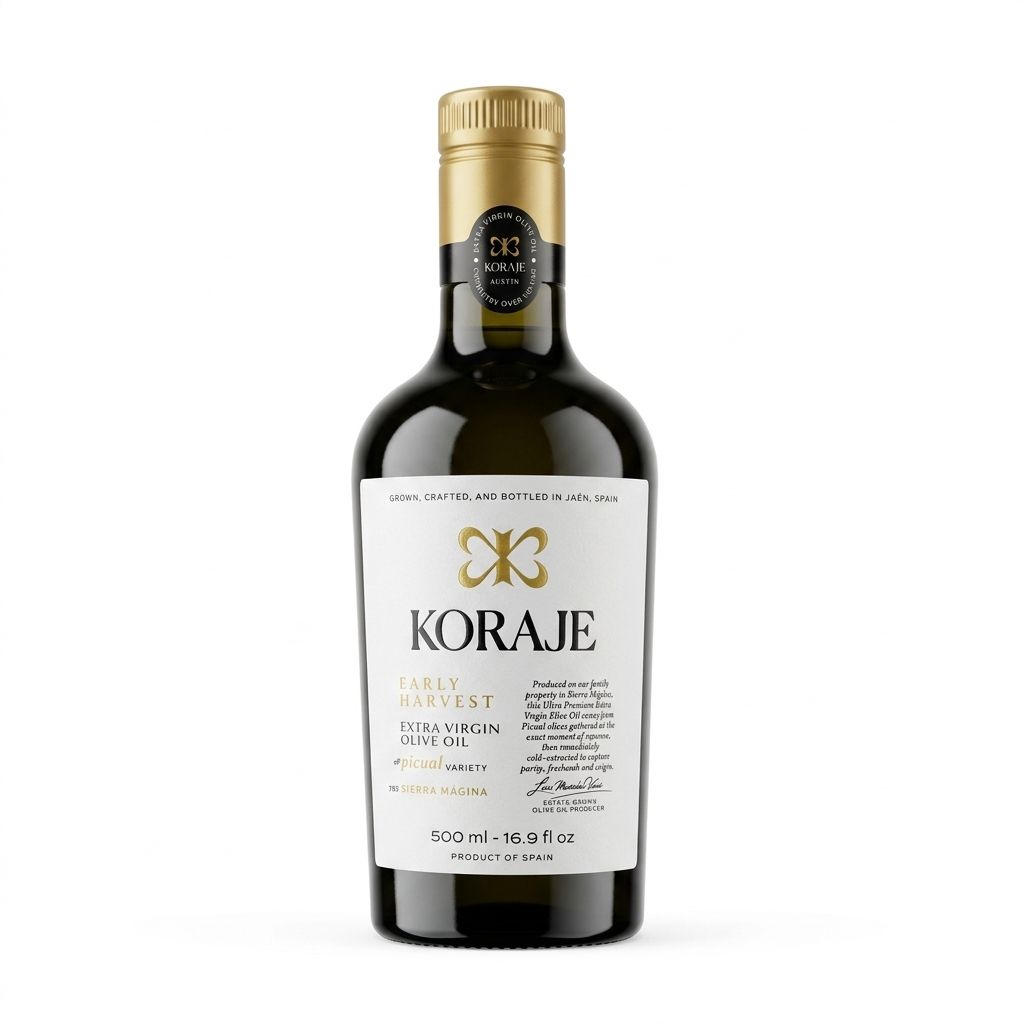
Read the numbers together, never one alone. Ours are in the table above, and you can taste them in KORAJE Early-Harvest Picual Extra Virgin Olive Oil.
Frequently asked questions
How do you test olive oil for oxidation?
A lab measures peroxide value and UV absorbance at 232 and 270 nm, the two official IOC methods. Research labs add p-anisidine value, TOTOX, gas chromatography of volatile compounds and Rancimat induction time.
What are the three types of rancidity?
Oxidative rancidity, caused by oxygen attacking unsaturated fats; hydrolytic rancidity, where water splits fatty acids off the fat molecule and raises free acidity; and microbial rancidity, where microorganisms such as yeasts produce enzymes that break down the fat.
How can I tell if my olive oil is oxidized at home?
Smell and taste it. Oxidized oil smells of crayons, putty or stale nuts and tastes flat or greasy. There is no reliable home kit. Only a lab gives numbers.
What is a good peroxide value for olive oil?
The extra virgin limit is 20 meq O₂/kg. Fresh, well-made oils usually sit well below it. Read it alongside K232 and K270, because peroxides can break down and make an old oil look better than it is.
What is the difference between K232 and K270?
K232 measures conjugated dienes, an early sign of oxidation. K270 measures conjugated trienes and carbonyl compounds, a later sign. Both are UV readings, and both have legal limits for extra virgin olive oil.
What is the TOTOX value?
Total oxidation: two times the peroxide value plus the p-anisidine value. It combines early and late oxidation in one number. It is not part of the olive oil grade.
Does a dark bottle really slow oxidation?
Yes. In storage studies, tin and dark glass kept olive oil's quality best, while clear glass and plastic let its antioxidants decline faster.
References
- Tarapoulouzi M, Agriopoulou S, Koidis A, Proestos C, El Enshasy HA, Varzakas T. Recent advances in analytical methods for the detection of olive oil oxidation status during storage along with chemometrics, authenticity and fraud studies. Biomolecules. 2022;12(9):1180. doi:10.3390/biom12091180
- International Olive Council. Trade standard applying to olive oils and olive pomace oils, COI/T.15/NC No 3/Rev. 21, 2025.
- International Olive Council. COI/T.20/Doc. No 35: Determination of peroxide value.
- International Olive Council. COI/T.20/Doc. No 19: Spectrophotometric investigation in the ultraviolet.
- International Olive Council. COI/T.20/Doc. No 15: Sensory analysis of olive oil, method for the organoleptic assessment of virgin olive oil.
- North American Olive Oil Association. How long does olive oil last?
- Eurofins. Rancidity and 5 tests you need to know.
- UC Davis Olive Center. Microbiological food safety of olive oil: a review of the literature.
- Laboratorio Juan Antonio Tello (Tentamus group). Report 60728093500, lot L-H1118826, 2026.

Written by Raj Mahat
Analytical Chemist
Metabolomics/ Lipidomics
EVOO Sommelier- O.N.A.O.O., Italy
Certified EVOO Sommelier- ESAO, Spain





Leave a comment
This site is protected by hCaptcha and the hCaptcha Privacy Policy and Terms of Service apply.