

How to Tell If Olive Oil Is Real: Kitchen Tests That Work, and the Fridge Test That Doesn't

Short answer: you can't prove olive oil is authentic in your kitchen, but you can catch most bad bottles. Skip the fridge test; researchers found it doesn't work. Instead, read the label for a harvest date, a specific origin, and dark glass, then taste the oil plain. Real, fresh extra virgin olive oil smells green or fruity, tastes a little bitter, and leaves a peppery catch in the throat. Flat, greasy or crayon-scented oil is old, refined, or mislabeled. Only a lab can confirm it.
The bottle on the shelf says extra virgin. It says Italy. It has a little painting of an olive branch and a farmhouse at sunset. Nobody in that farmhouse ever saw the oil inside. It came from three countries, two harvests ago, and spent last summer in a warehouse with a tin roof. The label is not lying, exactly. It is just telling you a bedtime story.
Why this matters: the scale of the problem
In 2010, the UC Davis Olive Center tested imported "extra virgin" olive oils bought in California stores. 69% of the imported samples failed international and USDA sensory standards for extra virgin, most for defects linked to oxidation, old oil or poor processing. Since then, European police operations have repeatedly found olive oil cut with cheaper oils or relabeled as a higher grade.
Most "fake" olive oil isn't poison. It's usually real olive oil sold as a better grade than it is: old, defective or refined oil labeled extra virgin. Outright blending with seed oil happens too, but less often.
The fridge test: why it fails
The idea: put olive oil in the fridge, and if it solidifies, it's real. In 2013, UC Davis researchers tested it. Oils cooled for days behaved inconsistently, and some known adulterated blends clouded while some genuine oils didn't solidify. Olive oil's solidification depends on its mix of fats and waxes, which varies naturally by variety and harvest. The test can't tell real from fake.
Same for the "lamp test" (real oil burns cleanly). Most vegetable oils burn in a wick.
How to spot genuine olive oil at home
1. Read the label like a detective
- Harvest date (not only a best-by date). Within the last 12–18 months.
- Specific origin. One estate, or a protected region like a PDO, beats "bottled in Italy" with a list of countries in small print.
- Dark glass or tin. Clear bottles are a warning.
- Price that makes sense. Real extra virgin costs real money to make. A liter at a rock-bottom price deserves suspicion.
- Lab report or certification. Producers who test usually show it.
2. Smell it
Pour a spoonful into a small glass, cover it, warm it in your hand and sniff. Good: cut grass, green tomato, artichoke, apple, almond, herbs. Bad: crayons or putty (rancid), vinegar (winey), damp cellar (musty), sweaty or fermented olives (fusty). No smell at all often means refined oil.
3. Taste it plain
Sip a little and slurp air through it. Extra virgin should show some bitterness on the tongue and some pungency, a peppery catch, in the throat. That pepper comes largely from oleocanthal, a compound refined and seed oils don't have. If your oil makes you cough, that's usually good news. (Step-by-step: how to taste olive oil like a sommelier.)
4. Compare
Taste your bottle next to one with a published lab report and a recent harvest. The difference is usually obvious within seconds.
Red flags at a glance
| Red flag | What it may mean |
|---|---|
| No harvest date | Age unknown; often old stock |
| Clear plastic or glass | Light damage likely |
| Long list of origin countries | Blend of unknown oils |
| "Pure," "light" or "olive oil" only | Refined blend, not extra virgin |
| Smells of nothing or crayons | Refined or rancid |
| No bitterness, no pepper | Old, very mild or not extra virgin |
| Price far below market | Too good to be true |
What only a lab can prove
Some fraud is invisible to the nose. Labs check:
- Free acidity, peroxide value and UV absorbance (K232, K270): freshness and grade.
- Fatty acid and sterol profiles: whether foreign oils like sunflower or hazelnut were added.
- Waxes and stigmastadienes: traces left by refining or pomace oil.
- Sensory panel: trained tasters scoring defects and fruitiness under IOC rules.
That's why we publish KORAJE's full report from Tello Lab, an IOC-recognized lab: 0.11% acidity, 9.2 meq O₂/kg peroxide value, K232 of 1.84, a sterol profile within extra virgin limits, and a panel score of fruitiness 7 with zero defects. Every bottle's batch number leads back to it. (How to read a lab report, and the deeper science in what metabolomics reveals about your bottle.)
Final Thoughts
Forget the fridge. Read the label, trust your nose, taste it plain, and buy from producers who show their lab work. A bedtime story on the label is pleasant. A lab report is the truth, and the truth tastes peppery.
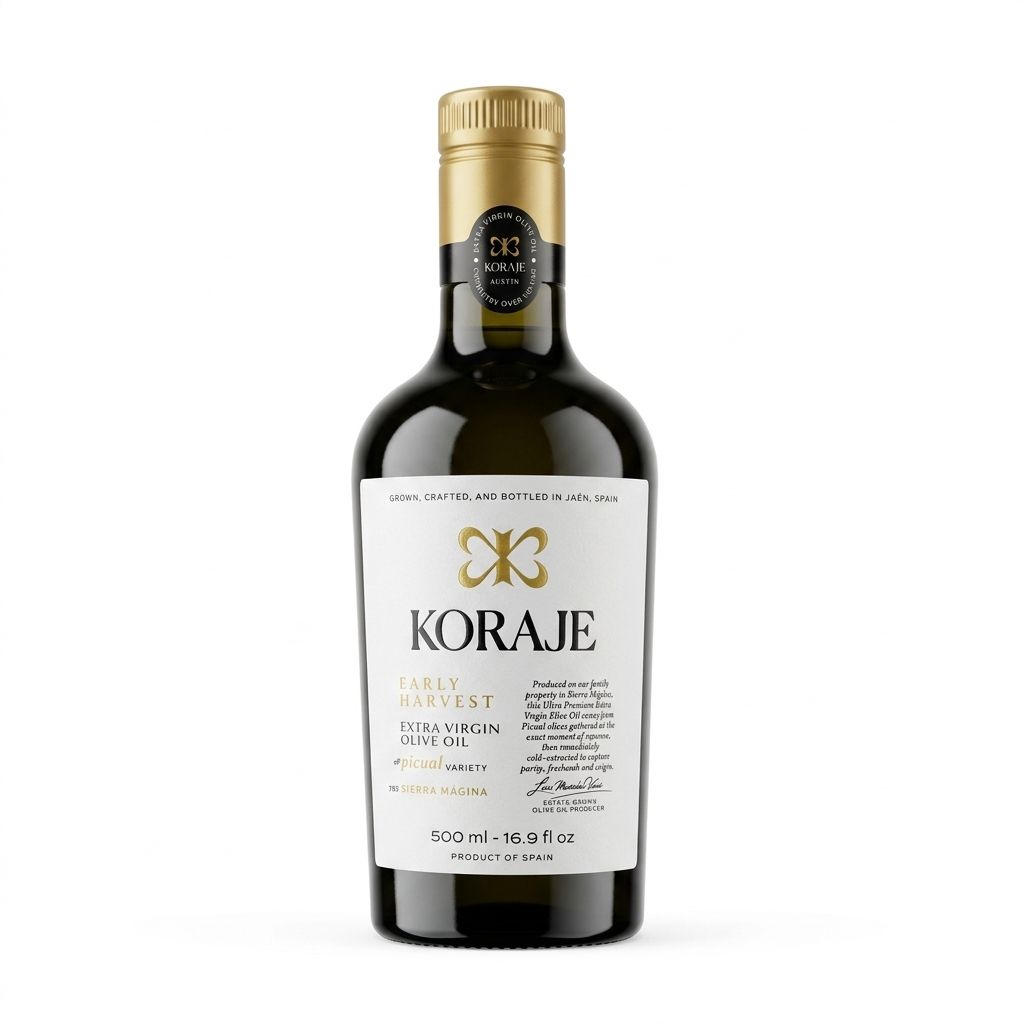
Verified, not just claimed: KORAJE Early-Harvest Picual Extra Virgin Olive Oil.
Frequently asked questions
Does the fridge test work for olive oil?
No. UC Davis researchers found that solidifying in the fridge doesn't reliably separate real extra virgin olive oil from fake or blended oil.
How can I tell if my olive oil is extra virgin at home?
Check for a harvest date, origin and dark glass, then taste it plain. Extra virgin should smell fresh and taste fruity, slightly bitter and peppery, with no off-smells.
How can you taste the difference between real and fake olive oil?
Often flat, greasy or bland. Old or defective oil can smell like crayons, vinegar or damp cellar.
How common is fake olive oil?
Mislabeling is common. In a 2010 UC Davis study, 69% of imported samples labeled extra virgin failed sensory standards.
Why does real olive oil burn my throat?
Fresh extra virgin contains oleocanthal, which triggers a receptor in the throat. The peppery catch is a sign of a fresh, phenol-rich oil.
References
View all references
- Frankel EN, Mailer RJ, Shoemaker CF, Wang SC, Flynn JD. Tests indicate that imported "extra virgin" olive oil often fails international and USDA standards. UC Davis Olive Center, July 2010.
- Wang SC, et al. Evaluation of extra virgin olive oil sold in California. UC Davis Olive Center, 2011.
- UC Davis Olive Center. Refrigeration is not a reliable method to assess olive oil quality, 2013.
- International Olive Council. Trade Standard Applying to Olive Oils and Olive Pomace Oils, COI/T.15/NC No 3.
- Europol. Operation OPSON reports on food fraud, including olive oil.
- Peyrot des Gachons C, et al. Unusual pungency from extra-virgin olive oil is attributable to restricted spatial expression of the receptor of oleocanthal. Journal of Neuroscience. 2011;31(3):999–1009.
- Tello Lab (IOC-recognized). Certificate of analysis, KORAJE lot L-H1118826, report 60728093500.

Written by Raj Mahat
Analytical Chemist
Metabolomics/ Lipidomics
EVOO Sommelier- O.N.A.O.O., Italy
Certified EVOO Sommelier- ESAO, Spain





Leave a comment
This site is protected by hCaptcha and the hCaptcha Privacy Policy and Terms of Service apply.