

Ten Spanish Olive Varieties: Origin, oil profile, and taste

Short answer: The ten common Spanish olive varieties for olive oil are Arbequina, Hojiblanca, Picual, Picudo, Cornicabra, Empeltre, Manzanilla Cacereña, Royal, Farga, and Lechín de Sevilla. Picual and Cornicabra make robust, bitter, and pungent oils with high polyphenols. Arbequina, Picudo, and Royal make milder, sweeter oils.
Spain is home to more than 200 native olive varieties, more than any other country on earth, and grows nearly half the world's olive oil supply on that foundation. That range didn't happen by accident. Different regions, soils, and microclimates across the country have shaped distinct cultivars over centuries, each producing oil with its own chemical signature: acidity, polyphenol content, oleic acid, flavor profile all shift from one variety to the next. Spain's olive heritage carries 33 Protected Designation of Origin (PDO) and 3 Protected Geographical Indication (PGI) labels, each tied to a specific variety or region and each a guarantee that what's in the bottle actually came from where the label says it did. Below are ten of the country's most important oil-producing varieties, the ones that define what Spanish extra virgin olive oil actually tastes like.
Spanish olive varieties at a glance
| Variety | Home region | Flavor notes | Bitterness & pungency | Polyphenols |
|---|---|---|---|---|
| Arbequina | Catalonia, Alto Aragón | Banana, apple, almond | Light | Low |
| Hojiblanca | Andalusia | Green apple, almond, grass | Moderate | Medium |
| Picual | Andalusia (Jaén), Castilla-La Mancha | Cut grass, tomato, artichoke | Intense | High |
| Picudo | Andalusia (Córdoba) | Green apple, olive leaf | Mild | Moderate to low |
| Cornicabra | Castilla-La Mancha, Extremadura | Apple, olive leaf | Bitter | Very high |
| Empeltre | Aragón, Balearic Islands | Green apple, almond | Slight | Medium |
| Manzanilla Cacereña | Extremadura | Cut grass, green apple, tomato | Balanced | Medium |
| Royal | Andalusia (Cazorla, Jaén) | Very fruity, fig | Light | Low to medium |
| Farga | Castellón, Tarragona | Green fruit, balanced | Moderate | Medium to high |
| Lechín de Sevilla | Western Andalusia | Fruity, green almond | Slight | Medium |
1. Arbequina: Catalonia's small, sweet olive
 Origin. Arbequina, whose name originated from the town of Arbeca in Lleida, is an olive native to Catalonia (Tarragona and Lleida) and Alto Aragón. However, it has made its way to South America and the United States (California) as well. Notably, the two PDOs, PDO Les Garrigues and PDO Siurana, are known to grow this olive variety in Spain.
Fruit and tree. Arbequina olives are small and oval-shaped with thin skin. The thin skin makes processing and oil extraction easier. The color of the fruit is green, which gradually turns brownish-purple as it ripens and dark brown or reddish when fully ripe.
The Arbequina olive trees are small to medium-sized bushy trees. They are resistant to both cold and drought, which makes them very adaptable and easy to grow. They are one of the highest fruit- and thus oil-yielding varieties.
Oil profile. The Arbequina oil has pleasant fruity and nutty aromas with hints of banana, apple, and almond. It typically has light bitterness and low pungency, resulting in a delicate taste. The oil has a low acidity (typically below 0.5%), desirable for EVOO. However, the polyphenol content and oleic acid content are low. Because of its lower oleic acid content, Arbequina oil is less stable against oxidation. Hence, its best-before date is typically only about 18 months.
Uses. The mild and delicate flavor of Arbequina oil makes it a good choice for baking. It is also good drizzled over cheesecakes and cakes, as well as other desserts, mild salads, and white fish.
2. Hojiblanca: Andalusia's "white leaf" olive
 Origin. Hojiblanca translates to "white leaf" in Spanish, referring to the white underside of its leaves. The Hojiblanca variety is native to Andalusia, Spain, and is primarily grown in the provinces of Málaga, Córdoba, Sevilla, and Jaén. It is one of Spain's top olive varieties suitable for both oil and table olive production and is cultivated on more than 200,000 ha.
Fruit and tree. The fruits are medium to large and oval in shape with a slightly pointed tip. The color changes from green to reddish-brown or dark purple as they ripen. The tree is medium-sized with a spreading, dense canopy. Harvesting is done in late autumn to early winter.
Oil profile. Hojiblanca oil has a distinctive flavor with a balance of fruity, nutty, and slightly bitter notes, with hints of green apple and almond. It can have an herbal or grassy aroma and moderate pungency/spiciness emanating from a medium level of polyphenols. Hojiblanca olive oil is often blended with other varieties to create balanced oils with moderate intensity.
Uses. Hojiblanca oil is versatile and works well for both cooking and dressing. It is often used in Mediterranean cuisine, especially for salads, dipping bread, grilling vegetables, and drizzling over meats.
3. Picual: the world's benchmark olive
 Origin. The Picual olive is the most abundant variety in Spain (900,000 ha), especially in Andalusia, and in the world. Besides Jaén, it is found in other Andalusian provinces, such as Córdoba and Granada, and in Ciudad Real in Castilla-La Mancha. The variety is also grown in South America (Argentina and Chile) and Australia. It is the flagship variety for high-quality olive oil production. The name refers to the pointed/beaked tip of its fruits.
Fruit and tree. Picual olive fruits are medium to large in size with an oval or elliptical shape. The color changes from dark green to deep black when ripe. The fruits have thick skin and high oil content, ideal for producing quality olive oil. It is one of the highest oil-yielding olive varieties (oil yield 20%–30%). Usually, harvesting time is late autumn to early winter, typically the end of December.
Oil profile. Picual olive oil has an intense and robust flavor and is often described as fruity, with prominent bitterness and pungency. These features come from high levels of oleocanthal, a polyphenol compound, and oleuropein (an antioxidant). The oil typically has a fresh, green fruity flavor with herbal notes like freshly cut grass, tomato, and sometimes hints of artichoke or almonds. It gives a sharp peppery kick at the back of the mouth or throat. The high polyphenol content in the oil causes its high stability (resistance to oxidation) and long shelf life.
Uses. Picual olive oil is an excellent choice for drizzling. Since it has a high smoke point (370 °F to 410 °F), it's also suitable for high-heat cooking, frying, and sautéing.
4. Picudo: Córdoba's aromatic, gentle olive
 Origin. Picudo olives are native to Spain and are cultivated significantly in the Andalusian provinces of Córdoba (Baena), Granada, Málaga, and Jaén.
Fruit and tree. Picudo olives are medium-sized and oval in shape with a slightly pointed tip, which translates to its name "Picudo" in Spanish. The color of the fruits changes from green to dark purple or black as they ripen. Picudo olives are harvested in late autumn to early winter.
Oil profile. Picudo olives make highly aromatic oils characterized by a green, fresh, fruity flavor with green apple and herbaceous olive leaf notes. The polyphenol and antioxidant content are moderate to low, so unlike Picual olive oil, its oil has mild bitterness and pungency.
5. Cornicabra: the goat's horn of Castilla-La Mancha
Origin. The term "cornicabra" translates to a goat's horn in Spanish, owing to its fruit shape. It is native to Spain and is the second most grown olive variety in Spain (270,000 ha) after Picual. It is cultivated in the Toledo and Ciudad Real provinces of the Castilla-La Mancha region. It is also cultivated in the Badajoz and Cáceres provinces of the Extremadura region and in Madrid.
Fruit and tree. The fruits are medium-sized and elongated in shape with asymmetry. The skin is thick and rough. The fruit productivity is high and alternate.
Oil profile. Cornicabra is one of the most prized olives in Spain for the high yield and quality of its oil, which has remarkable organoleptic characteristics. Due to its very high polyphenol content, the taste is bitter and the oil is stable. The EVOO presents a highly aromatic flavor with notes of fruit, including apple and olive leaf.
6. Empeltre: Aragón's grafted olive
 Origin. Empeltre olives are typically grown in Aragón (Zaragoza and Teruel) and other areas such as the Balearic Islands, Castellón, and the Tarragona province of Catalonia. The name derives from the Catalan word "empelt," which translates to "graft" in English. It covers more than 70,000 ha and is one of the most widespread varieties in Spain.
Fruit and tree. The fruit is medium-sized, elongated, and slightly asymmetric. It is used for both oil production and black pickling. This variety is rated very highly for the excellent quality of the oil it generates.
Oil profile. Empeltre olive oil is sweet, slightly peppery, and bitter, with notes of green apple and almonds. The EVOO has a medium polyphenol content.
7. Manzanilla Cacereña: Extremadura's dual-purpose olive
 Origin. Manzanilla Cacereña olives are a typical variety of the Extremadura region and are grown in the provinces of Cáceres and Badajoz. They are also grown in other regions, such as Castilla y León (Salamanca) and Madrid. Outside of Spain, they are also grown in Portugal. They are grown for oil production as well as table olives and cover an area of about 64,000 ha in Spain.
Fruit and tree. The fruits are large, fleshy, and somewhat asymmetrically spherical.
Oil profile. Manzanilla Cacereña produces a balanced oil in terms of flavors, such as peppery, bitter, and sweet. The fruitiness resembles freshly cut grass, green apple, and tomato.
8. Royal: Sierra de Cazorla's rare olive
 Origin. The Royal olive is a native variety of Jaén province, especially the Cazorla district, in the Andalusia region. It is also known as Royal de Cazorla and is found almost nowhere else. Along with Picual, it is one of the two varieties protected under the PDO Sierra de Cazorla.
Fruit and tree. The fruit is large, fleshy, and thick-skinned with an asymmetric ovoid shape. It turns violet to black when ripe. Its tree is weak, with drooping branches and brittle wood. The fruit holds tightly to the branch, so the tree can be damaged during harvesting. Royal flowers earlier but ripens later than Picual.
Oil profile. The Royal variety offers a medium-to-low content of very good quality oil. The character of the oil is in contrast to that of Picual, the most abundant variety in the province. It offers a sweet and very fruity oil with fig notes.
9. Farga: the ancient olive of Castellón and Tarragona
 Origin. Farga is one of the oldest olive varieties in Spain. It is grown mainly in Castellón (Baix Maestrat) and in the southern Tarragona province of Catalonia, with some presence in Lleida. It covers about 17,000 ha. Many Farga groves are centuries old, and some trees are believed to be more than a thousand years old.
Fruit and tree. The Farga trees are vigorous and resilient, with an open growth habit and a dense canopy. They tolerate moderate winter frost. The bearing is late and alternate. The fruit is elongated and black when ripe, with high oil yield, and is used only for oil production. The fruit holds tightly to the branch, so the trees are not suitable for mechanical shaker harvesting.
Oil profile. The Farga oil is high in oleic acid (about 78%) and low in polyunsaturated fat (about 7.5% linoleic acid). The oil is highly stable and has a medium-to-high polyphenol content. It has a medium-to-high green fruitiness with good balance, making it suitable both as a single-variety oil and in blends.
10. Lechín de Sevilla: the "milky" olive of western Andalusia
 Origin. Lechín de Sevilla is the fourth most grown olive variety in Spain (about 185,000 ha). It is grown in the Andalusian provinces of Sevilla, Córdoba, Cádiz, Málaga, and Huelva. The name is commonly linked to "leche" (milk) in Spanish, referring to the whitish flesh of the fruit. It is different from the Lechín de Granada variety. It is one of the varieties of the PDOs Estepa, Sierra de Cádiz, and Montoro-Adamuz.
Fruit and tree. The tree is robust and highly productive, but its bearing is alternate. It is resistant to drought and adapts well to limestone soils. The fruit is medium-sized and ovoid, ripens early, and turns purplish-black when ripe. It is used mainly for oil and also for black table olives. The fruit holds tightly to the branch, which makes harvesting difficult and costly.
Oil profile. The Lechín de Sevilla oil is fruity and sweet, with slight bitterness and pungency and notes of green almond. Its oleic acid, linoleic acid, and polyphenol contents are average, and so is its stability. Therefore, it is often blended with more stable varieties such as Picual or Hojiblanca.
Final thoughts
Each Spanish variety writes its own chemistry into the oil. Picual and Cornicabra bring polyphenols, bitterness and long shelf life. Arbequina brings softness and sweetness. Know the variety, and you know what to expect in the glass.
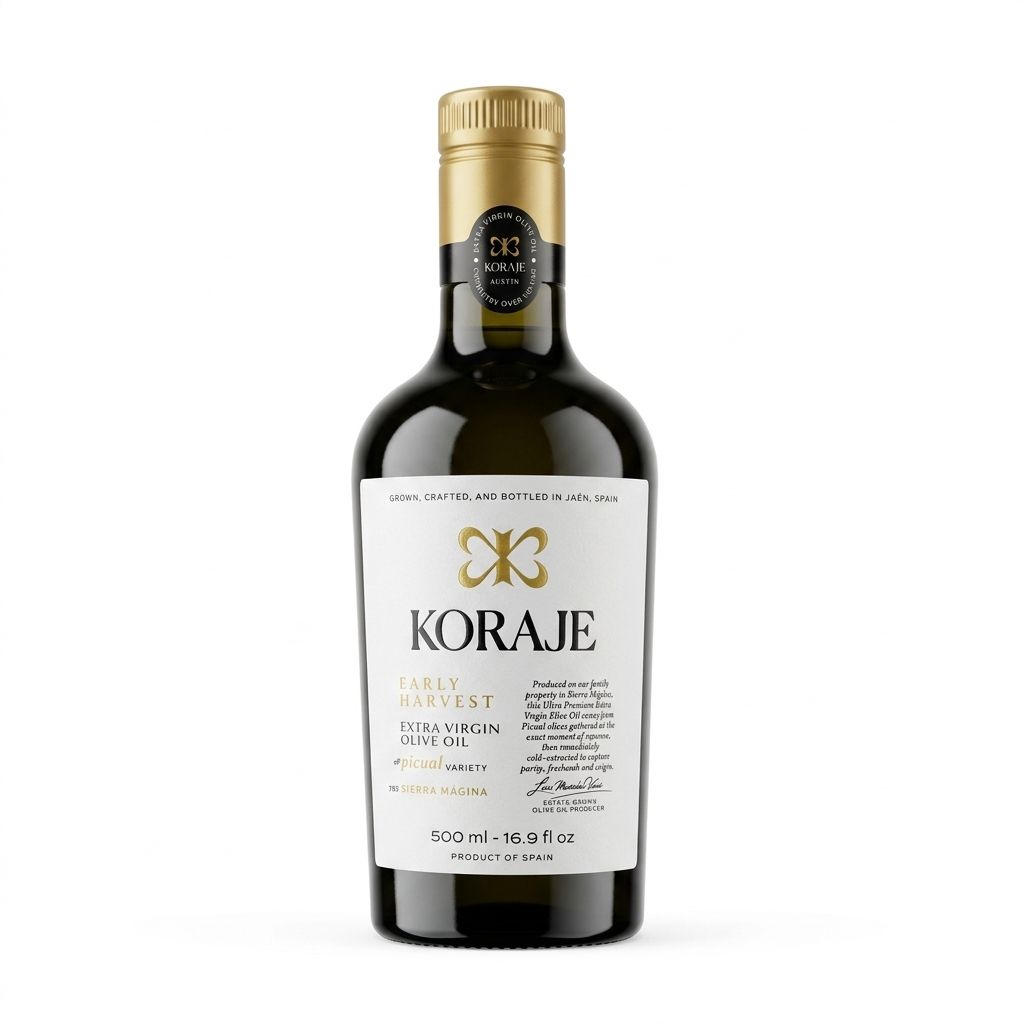
To taste the benchmark for robust Spanish oil, try KORAJE Early-Harvest Picual Extra Virgin Olive Oil, from a single estate in PDO Sierra Mágina.
All the images are reproduced with permission of University of Cordoba.
Frequently asked questions
How many olive varieties are grown in Spain?
Spain grows more than 200 native olive varieties, though only a smaller number are cultivated widely enough for commercial oil production.
Which Spanish olive is best for oil?
Picual is Spain's most widely planted oil variety and the benchmark for robust, high-polyphenol EVOO, but "best" depends on use. Arbequina suits a delicate finishing oil, while Picual or Cornicabra suit high-heat cooking and long shelf stability.
What's the difference between Picual and Arbequina olive oil?
Picual produces a bold, peppery, high-polyphenol oil with strong stability and a high smoke point. Arbequina produces a milder, sweeter, nuttier oil with lower polyphenol and oleic acid content, better suited to finishing than cooking.
Which Spanish olive oil has the most polyphenols?
Cornicabra and Picual both rank among the highest in polyphenol content of Spain's major varieties, which is what gives their oils bitterness, pungency, and long shelf stability.
What does "oleic acid content" mean for olive oil quality?
Oleic acid is the dominant monounsaturated fat in olive oil. Higher oleic acid content is generally linked to better oxidative stability, meaning the oil resists rancidity and holds its quality longer.
References
- Barranco, D. (1994). Estructura varietal del olivo en España. Agricultura, Ministerio de Agricultura, Pesca y Alimentación. mapa.gob.es
- Barranco, D. (1997). Las principales variedades de olivo en España. Vida Rural, 55, 32–34. mapa.gob.es
- Ministerio de Agricultura, Pesca y Alimentación. Pliego de condiciones de la Denominación de Origen "Sierra de Cazorla". mapa.gob.es
- 'Farga' Olive (2018). Journal of the American Pomological Society, 72(1). doi:10.71318/apom.2018.72.1.21
- OLIVATERM, Universidad de Jaén. Terminology entries for Farga and Lechín de Sevilla. olivaterm.ujaen.es
- International Olive Council (2000). World Catalogue of Olive Varieties. Madrid: IOC.

Written by Raj Mahat
Analytical Chemist
Metabolomics/ Lipidomics
EVOO Sommelier- O.N.A.O.O., Italy
Certified EVOO Sommelier- ESAO, Spain





Leave a comment
This site is protected by hCaptcha and the hCaptcha Privacy Policy and Terms of Service apply.